
Read the original article
BärGPT launches as a new AI assistant for Berlin’s state administration. While we receive very positive feedback from employees, there are also critical voices in public discourse: Why a custom development when solutions from other federal states already exist? A perspective by Ingo Hinterding, Head of Development at CityLAB Berlin.
The development of AI applications for public administration is booming – and that’s a good thing. Whether generative text assistants, specialized analysis tools, or automated document processing: the possibilities are vast, and many dedicated teams are working to make government more digital and efficient. This pressure to innovate is a sign of a disruptive technology that is fundamentally changing work processes.
At the same time, the debate around software reuse in public administration is nothing new – and it’s an important one. The principle of “one for all” saves resources, avoids duplication of effort, and makes it possible to learn from others’ experiences. Especially in federal Germany, where 16 states and thousands of municipalities maintain their own administrative structures, the potential is enormous. No one should have to reinvent the wheel when functional solutions already exist.
The Reality Is More Complex
But practice shows: reuse only works when the corresponding offerings are available, high-quality, and adaptable. And that’s exactly where things get complicated. When we began evaluating AI solutions for Berlin’s administration in spring 2025, we thoroughly examined existing offerings from other federal states. We tested these systems, conducted user tests with Berlin administration employees, and analyzed the results.
The conclusion was sobering: the tested solutions did not meet our requirements. They were either functionally limited, cumbersome to use, or simply not at the same technical level as our own initial prototypes. The feedback from user tests was consistently negative – not a good foundation for a tool that tens of thousands of employees are supposed to use daily.
On top of that, there were practical hurdles: many offerings were simply not available – either because they were still in early development stages, or because the processes for cross-state collaboration were missing. Some systems were proprietary and not available as open source, others were priced well beyond what we could justify. And even where there was basic interest, it became clear that adopting an existing product is by no means a straightforward process – it can drag on for months or even years.
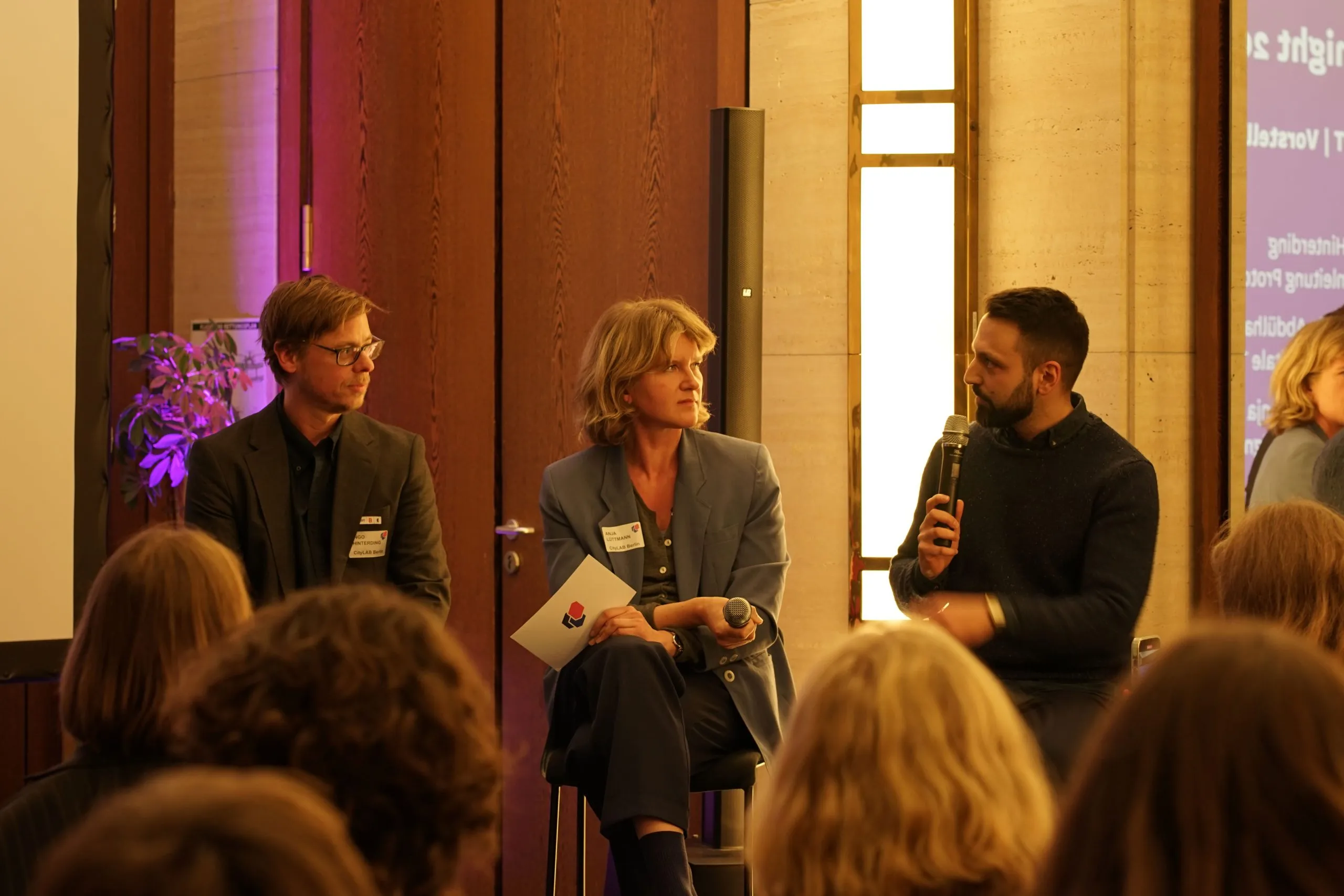 BärGPT Panel Discussion
Digital Sovereignty Means the Ability to Shape Technology
There is currently much discussion about digital sovereignty, but there are differing views on what it actually means. For us, sovereignty is more than the question of whether the OpenAI server is located in the EU or the US. For us, sovereignty means the ability to design, operate, and further develop technology ourselves, as well as to respond quickly and directly to new needs and requirements. Anyone who relies exclusively on external offerings becomes dependent on conditions they cannot control: pricing structures, development priorities, and availabilities that are not their own.
After conversations with other federal states, our impression remained: reuse would have made us second-class users at best. Development would have been oriented toward the needs of the originating state, and our specific requirements would have been treated as secondary. For a pilot project that needs to work in an agile and user-centered way, that’s not a viable foundation.
Competition Drives Innovation
It’s worth taking a more nuanced approach to the reuse debate. Of course it’s right to evaluate and use existing solutions where it makes sense. But it’s short-sighted to categorically demand that no new offerings be developed – especially in a field as dynamic as artificial intelligence.
A look at other domains shows: competition creates diversity, innovation, and better products. No one would seriously argue that we only need one operating system, one browser, or one office suite. iOS and Android, Windows, macOS and Linux, Chrome, Firefox and Safari – all these offerings exist in parallel and push each other toward better solutions. Users benefit from this diversity through more choice, fair prices, and continuous improvement.
Why should it be any different for AI assistants? Precisely because we are in a phase of rapid development, it’s important that different approaches are tested, compared, and refined. What starts as a prototype today may become the standard tomorrow – or disappear from the market because other solutions are better. That’s a normal and healthy process.
Specialization Over One-Size-Fits-All
Another important point: we need to let go of the idea that everything related to AI must flow into a single consolidated product. Software that tries to do everything usually does nothing well. It’s a good thing that you can’t edit videos in Microsoft Excel or create PowerPoint presentations in Outlook. We should think about AI applications the same way.
Just because a large language model is being used doesn’t mean all use cases need to be served by the same software. Artificial intelligence is a hype topic – rightfully so – but ultimately it’s just another component in the development of user-centered applications. A product uses AI; AI is not the product. We need to look at the requirements for software, not at which technical components are built in.
The future lies in specialization: away from the general chatbot, toward offerings that use artificial intelligence to serve highly individual use cases. An AI assistant for legal document analysis needs different features than a tool for automated citizen inquiry response. That requires dedicated offerings – not a one-size-fits-all product that does everything a little bit.
The Best of Both Worlds
The solution doesn’t lie in either/or, but in constructive collaboration. Reuse makes sense when products are readily available, high-quality, and adaptable to one’s own needs. In the case of BärGPT, after careful consideration, we concluded that a custom development would deliver a faster, more affordable, and qualitatively better result than reuse would have allowed – and in retrospect, that assessment proved correct.
Openness and interoperability of our products remain important values for us nonetheless. Like all our developments, BärGPT is open source and thoroughly documented, so that others can benefit from our work – and we from their contributions.
Conclusion
Reusing an existing solution can be a good option in many cases to reduce workload and avoid unnecessary duplication. However, especially with a topic as young as AI, it should not lead to innovation being stifled in its infancy. The development of AI for public administration is still in its early stages, and there is still much to learn. When different solutions emerge in parallel during such a phase, that’s not a problem – it’s a sign of vibrant competition that promotes innovation and improves quality. Because while you don’t always need to reinvent the wheel, every now and then you should give it another spin.